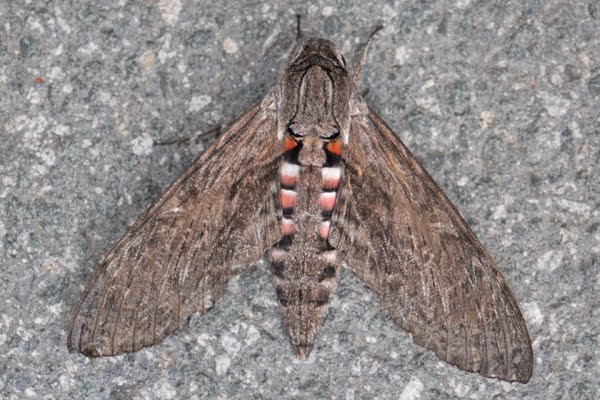
Convolvulus Hawk-moth 25th September 2011
Convolvulus Hawk-moth 25th September 2011
In order to see migrant moths in autumn it's best to get southerly winds extending as far into Europe and Africa or even the Middle-east as possible. Days of checking Surface Pressure chart data, the Sahara Wind forecast and European temperature map are usefull indicators for an all too often narrow window of opportunity. Unlike birds, moths only tend to turn up with tailwinds which can make prediction much easier. As soon as the warm component in the winds is felt there is a good chance that these have been heated up in warm countries much farther south and the migrants will be passing through that night. The warm air will keep the temperatures up on a cloudless night which is vital for getting moths on the wing. Cloud cover is another way of getting temperatures up at night and even though the night may feel cold and look lifeless around the trap it can all suddenly change with the passing of a frontal system. These fronts can also be an indication of migrant timing as the cloud could be moisture sucked up whilst travelling over the English Channel. Running a trap as this front passes could be more productive than the rest of the night put together so even if you leave the trap unattended over night it's worth popping out to net any moths that don't get in the trap at this critical time. This I experienced in the early hours of Sunday 23rd October 2011 when a weak front came through between 3am and 4am. Despite being a windy night and at an altitude of around 60 metres the moths were still spiraling down from height to visit the trap. Any month can potentially score with migrants although historically December, January and February don't tend to see much activity. The number of species on the wing varies abroad in much the same way as here so the late autumn and winter period will see far fewer moths on the wing and therefore fewer travelling to the UK. Don't be caught out however as Portland Bill in January and February 2004 recorded some great migrants.
My theory when it comes to predicting the type of species you get are to look at the wind speed. The lighter the wind, the smaller the moth you get. So if you get light southerly winds in theory you should be in for a treat or should you? Moths have flight boundary layers and can fly anything up to 500 metres so ideally you need to get a bit of height to get a more productive catch (having said this, 180+ Silver Y were caught on the Black Mountains at altitudes between 500 and 750 metres on 2nd July 2012). Failing this a bit of low level cloud with bring the moths down to a more trapable level from the ground. This is why a warm muggy night is often the best weather for getting those big rarities. Sadly their occurences are all too brief and some years only a handfull of occasions but they do happen annually.
Moth conditions: Late October: Moths coming through at the end of October 2011 were in complete contrast to the moths in late September being in a much more worn state. Late September: The Convolvulus was in good condition but there was some wear towards the wing tips so a guess of a few days old would sound accurate. Several species of moth caught were in pristine condition: Silver Y, Udea ferrugalis, Palpita vitrealis, The Delicate, Vestal, Hellula undalis, Four-spotted Footman. Others were consistently worn: Pearly Underwing, Dewick's Plusia. Scarce Bordered Straw showed a mixture of pristine and partly worn.
Timing: Apart from Silver Y all the migrants consistently turned up between 1am and 4am. Sunset is around 18:45 at this time and full darkness c.7:15 so an estimate of 6 hours to start reach the trap would be about right.
Conclusion: Warm southerly winds will bring migrant moths into the country and very quickly. Their timing and path of migration is very specific. Trapping in the early hours on the coast is likely to be the most productive method of interception. My trap was ran at 46 metres above sea level which gave an advantage over the sea level trappers.
Species recorded in North Somerset between 25th September and 22nd October:
Convolvulus Hawk-moth, Delicate, Pearly Underwing, Silver Y, Udea ferrugalis, Four-spotted Footman, Vestal, White-point, Palpita vitrealis, Scarce Bordered Straw, Dark Sword-grass, Dewick's Plusia, Pale-lemon Sallow, The Gem, Cosmopolitan, Mecyna asinalis.